7 Premium Mineral Water Picks for Restaurant-Style Dining
Last Updated: November 10, 2026
Quick Summary
Premium mineral water is natural water drawn from a protected underground source, whose mineral content gives it a distinct taste. Choose it by comparing taste and mineral profile, carbonation, packaging, service format, cost per cover, and best-fit dining occasion. Still water is the default table pour, while sparkling suits the welcome, aperitif, and toast.
- AUR'A still water sits at approximately 430 mg/L TDS with a pH of 8.25.
- A 750 ml case of six costs $89.00, or $14.83 per bottle.
- A 330 ml case of twelve costs $95.00, or $7.92 per bottle.
- Subscriptions cost $75 per month for 750 ml or $80 per month for 330 ml.
- Keep both still and sparkling on the table, but let the server lead.
Table of Contents
- Why Premium Mineral Water Belongs on the Dining Table
- The Best Bottled Water for Restaurants: A Side-by-Side Comparison
- Mineral Content and Total Dissolved Solids: What the Numbers Mean
- Still vs Sparkling Mineral Water: Choosing for the Course
- Water Pairing with Food: A Course-by-Course Guide
- Fine Dining Water Service: Temperature, Glassware, and Staff Training
- Restaurant Economics: Transparent Cost Modeling for Premium Water
- Build Your Restaurant Water Program with AUR'A Gold Water
- Frequently Asked Questions
Why Premium Mineral Water Belongs on the Dining Table
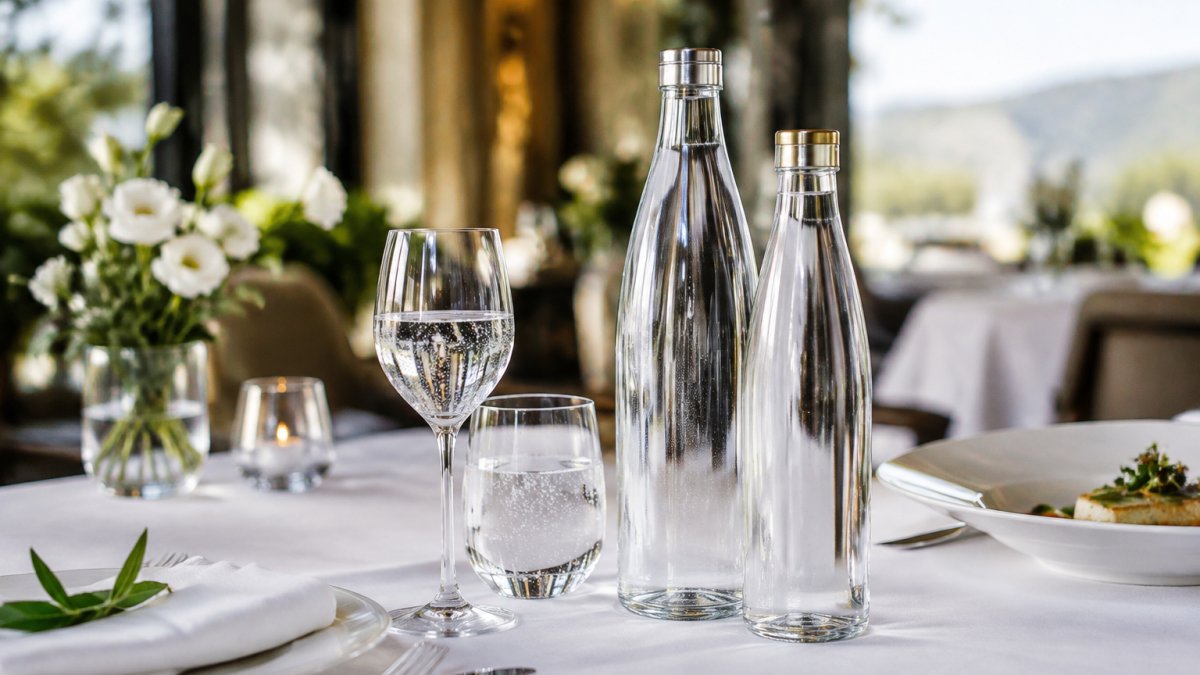
Premium mineral water for restaurant-style dining is no longer an afterthought. It is part of the table setting, the pacing of a meal, and the impression a guest carries home. At AUR'A Gold Water, we treat water as a course, not a condiment.
The reasoning is simple. A guest at a fine dining table notices what is poured, how it is poured, and what it tastes like between bites. Water that tastes flat or vaguely chemical undercuts a kitchen doing careful work.
Premium mineral water is natural water drawn from a protected underground source, whose mineral content gives it a distinct taste.
Three things separate it from ordinary bottled water: a named source, a stable mineral profile, and packaging that respects both. Below, we break down how to choose it, how to serve it, and what it costs to run a water program that guests remember.
The Best Bottled Water for Restaurants: A Side-by-Side Comparison
The best bottled water for restaurants balances taste, presentation, and per-table cost. There is no single winner, because a 750 ml shared bottle and a 330 ml individual bottle do different jobs. What most buying guides skip is a consistent framework. Below we apply the same six criteria to every format and style, so the trade-offs are visible instead of implied.
The Six Criteria We Use
Every water in a restaurant program can be judged on the same six axes:
- Taste and mineral profile, TDS, hardness, and the calcium-magnesium-bicarbonate balance.
- Carbonation, still, lightly sparkling, or fully sparkling, and whether the gas is natural or injected.
- Packaging, glass versus PET, bottle shape, label presentation, and recyclability.
- Service format, shared bottle, individual bottle, or carafe, and how each affects staffing.
- Cost per cover, wholesale bottle cost divided by realistic pours per bottle.
- Best-fit dining occasion, the courses and venues where the format earns its place.
Format Comparison: Shared Versus Individual
| Criterion | 750 ml Shared Bottle | 330 ml Individual Bottle |
|---|---|---|
| Taste and mineral profile | Same source water | Same source water |
| Carbonation | Available still or sparkling | Available still or sparkling |
| Packaging | Glass, taller bottle, label reads well from across the table | Glass, compact bottle, label reads at arm's length |
| Service format | Server pours at the table; one bottle per 2-3 guests | Guest opens their own; one bottle per guest |
| Cost per cover | Roughly one bottle shared across a table of four | $7.92 per guest |
| Best-fit occasion | Tasting menus, seated dinners, wine-style service | Bars, meetings, guest rooms, events with uncertain headcount |
| Per-bottle cost | $14.83 | $7.92 |
| Case price | $89 for 6 | $95 for 12 |
| Waste profile | One bottle per 2-3 guests | One bottle per guest |
Style Comparison: Still Versus Sparkling
| Criterion | Still | Sparkling |
|---|---|---|
| Taste and mineral profile | Mineral character reads directly; TDS and pH dominate the impression | Carbonation masks some mineral nuance and adds texture |
| Carbonation | None | Natural or injected; natural tends to a finer bead |
| Packaging | Glass, often taller | Glass, often with a shorter, stronger neck |
| Service format | Wine glass or tumbler | Tumbler or stemmed glass, poured slightly warmer |
| Cost per cover | Lower, because still is the default pour | Slightly higher when used as an aperitif pour |
| Best-fit occasion | Across every course, amuse-bouche to dessert | Welcome, aperitif, fried or rich dishes, cheese, toast |
What the Comparison Shows
The tables make the trade-off visible. Larger bottles lower the cost per pour and create a service moment. Smaller bottles raise cost per ounce but simplify logistics and reduce waste at events with uncertain headcount. Still water is the workhorse; sparkling is the accent. A restaurant that stocks only one format is usually leaving either margin or guest experience on the table.
For a restaurant weighing bottle formats for table service, our guide to choosing 330 ml or 750 ml bottled water walks through the same decision in more detail.
Mineral Content and Total Dissolved Solids: What the Numbers Mean
Total dissolved solids (TDS) measures the minerals left in water after evaporation, expressed in milligrams per liter. TDS is the single most useful number for predicting how water will taste alongside food.
AUR'A still water sits at approximately 430 mg/L TDS with a pH of 8.25, which places it in the middle: enough mineral character to taste like something, not so much that it fights the food. Calcium and magnesium shape the mouthfeel; bicarbonate softens acidity; sodium adds roundness. For buyers who want the underlying detail, our mineral composition and certificates page publishes the laboratory reports and Kosher Parve certification.
Still vs Sparkling Mineral Water: Choosing for the Course
Still water is the default for the table. It cleans the palate without adding texture, so it works across every course from amuse-bouche to dessert.
Sparkling water can suit specific moments such as the welcome, the aperitif, and the toast.
A practical rule we recommend: keep both on the table, but let the server lead. Guests who are told which water suits which course tend to drink more of both.
Water Pairing with Food: A Course-by-Course Guide
Water pairing with food follows the same logic as wine pairing, with one advantage. Water never competes for alcohol, so it can be matched purely on taste and texture. The weakness of most pairing advice is that it stops at "still with fish, sparkling with fried food." A useful guide has to account for dish intensity, fat and acid, carbonation, and the mineral weight of the water itself. Here is the framework we use, followed by a matrix you can hand to a server.
The Four Variables That Decide a Pairing
- Dish intensity, delicate, medium, or rich. Lighter dishes want quieter water; richer dishes want more texture and carbonation.
- Fat and acid, fat needs carbonation or mineral weight to cut it; acid needs bicarbonate to soften it.
- Carbonation, sparkling lifts and resets the palate; still cleans without adding texture.
- Mineral weight (TDS), low-TDS water disappears behind delicate food; high-TDS water holds up to reductions and aged cheese.
The Pairing Matrix
| Course or dish style | Intensity | Recommended water | Why it works |
|---|---|---|---|
| Raw fish and shellfish | Delicate | Still, low-mineral (under 150 mg/L TDS) | Anything assertive overwhelms delicate flesh |
| Salads and vegetable starters | Delicate to medium | Still, moderate minerals | Bicarbonate softens vinaigrette acidity |
| Roasted vegetables and braised dishes | Medium to rich | Sparkling | Carbonation cuts through oil and long-cooked richness |
| Aged cheese | Rich | Sparkling, served slightly warmer | Lifts the fat and resets the palate |
| Red meat and reduction sauces | Rich | Still, fuller mineral profile (above 400 mg/L TDS) | Holds up where a delicate water disappears |
| Dessert, fruit-driven | Medium | Still, or sparkling if acidic | Acidity and carbonation refresh without cloying |
| Dessert, chocolate or cream | Rich | Still, fuller mineral profile | Mineral weight matches the fat and sugar |
Cuisine Adjustments
The matrix holds across cuisines, but the accent shifts:
- Japanese and other delicate seafood cuisines: lean still and low-TDS throughout; sparkling only as a welcome.
- Mediterranean and vegetable-forward menus: still with moderate minerals for most courses; sparkling for grilled and fried plates.
- French and Italian tasting menus: open with sparkling, move to still for the main courses, return to sparkling for cheese.
- Steakhouse and grill menus: still with a fuller mineral profile for the main; sparkling for the opener and the cheese course.
- Spicy cuisines: sparkling throughout, because carbonation and mineral weight both temper heat.
Service Notes
A practical rule we recommend: keep both still and sparkling on the table, but let the server lead. Guests who are told which water suits which course tend to drink more of both. Train servers to name the variable, "this one is still and low-mineral, so it won't fight the crudo", rather than reciting a script.
Serve lightly chilled.
Fine Dining Water Service: Temperature, Glassware, and Staff Training
Fine dining water service is a discipline, not a garnish. Three variables decide whether the water lands as intended: temperature, glassware, and the person pouring it.
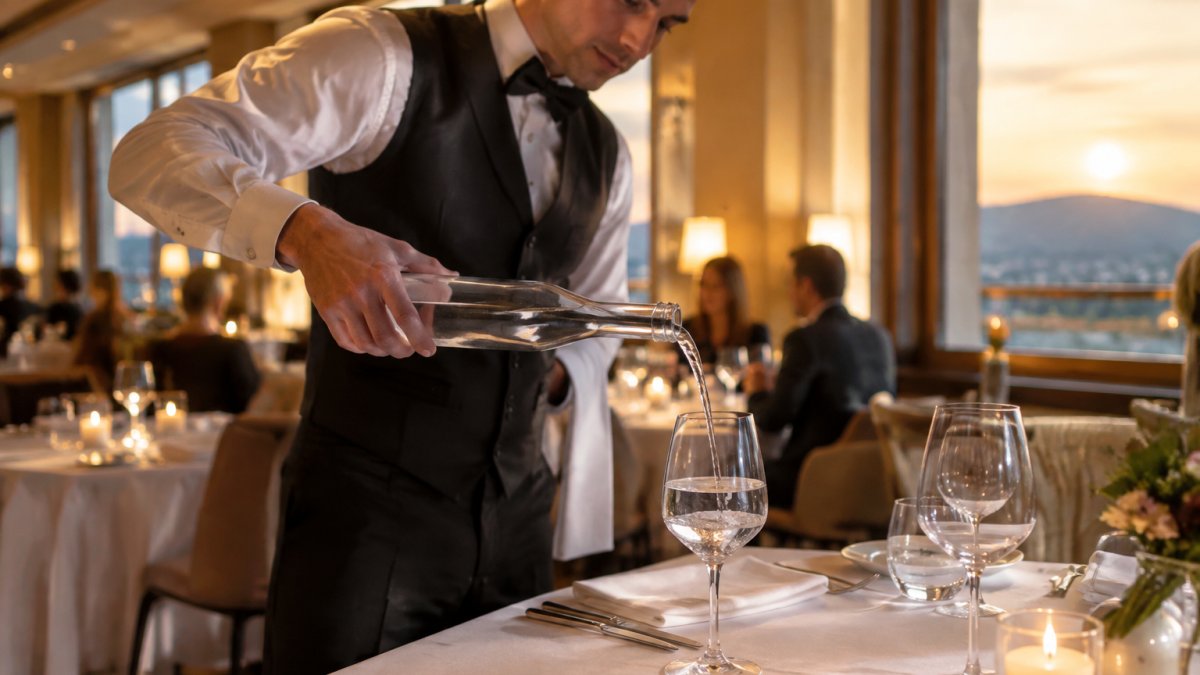
Serve lightly chilled.
For hotels, restaurants, and event teams, our events and hospitality page shows how the range fits those settings.
Restaurant Economics: Transparent Cost Modeling for Premium Water
Premium water is a margin decision, so model it honestly. A 750 ml case of six costs $89.00, or $14.83 per bottle, with complimentary shipping nationwide. A 330 ml case of twelve costs $95.00, or $7.92 per bottle.
Now do the per-cover math. A 750 ml case of six costs $89.00 and a 330 ml case of twelve costs $95.00, so per-bottle prices are $14.83 and $7.92 respectively.
Subscriptions change the math further: $75 per month for the 750 ml case, or $80 per month for the 330 ml case, both shipping included and cancellable anytime. For a buyer modeling real numbers against a menu, the 750 ml case of six lists the exact price and product detail to calculate from.

Per-bottle and case prices for AUR'A water formats
Build Your Restaurant Water Program with AUR'A Gold Water
A water program fails for boring reasons: inconsistent supply, unclear pricing, and staff who cannot explain what they are pouring. Fix those three and the rest follows.
AUR'A Gold Water is bottled at the source in Romania's Banat Mountains, in glass, in still and sparkling expressions. It carries trace gold and silver detected by ICP-MS laboratory analysis, a pH of approximately 8.25, and a Diamond Taste Award from the International Taste Institute in Brussels. Complimentary nationwide shipping is included, and subscriptions can be cancelled anytime.
If you are setting up a program across multiple venues, apply for a wholesale or trade account and we will walk through volumes and delivery.
The challenge is not finding premium water. It is building a service standard around it that your team can repeat every night. AUR'A Gold Water gives you the product side: a named source, published mineral analysis, glass packaging, and nationwide shipping. Get started with AUR'A Gold Water and build a water program your guests notice.
Frequently Asked Questions
What is the best premium mineral water for restaurant-style dining?
The right pick depends on your menu and service style. Look for a water with a total dissolved solids level (AUR'A is approximately 430 mg/L) and glass packaging. AUR'A Gold Water is bottled at the source in Romania's Banat Mountains, with a pH of 8.25, trace gold and silver, and a Diamond Taste Award from the International Taste Institute. It comes in 750 ml bottles for table service ($89.00 per case of six) and 330 ml bottles for individual pours ($95.00 per case of 12).
Should you serve still or sparkling mineral water with dinner?
Serve both, and let the course decide. Still and sparkling water are both served with meals; choose by the course and by taste. The AUR'A Gift Box ($69.00) pairs one 750 ml still and one 750 ml sparkling bottle, which makes it easy to test both expressions at the same table before committing to a full case.
How does mineral content affect the taste of bottled water?
Total dissolved solids (TDS) is the clearest indicator. Water under 500 mg/L tends to taste soft and clean, which is why it pairs well with fine dining. Higher TDS, driven by calcium, magnesium, sodium, and bicarbonate, adds weight and a mineral edge that can clash with delicate flavors. AUR'A still water sits at roughly 430 mg/L TDS with a pH of 8.25, a profile of approximately 430 mg/L TDS with a pH of 8.25.
How should premium bottled water be served at the table?
Serve lightly chilled. For restaurants, the 330 ml case of 12 ($95.00, $7.92 per bottle) works well for individual covers, while the 750 ml case of six ($89.00, $14.83 per bottle) suits shared table service. Complimentary nationwide shipping applies to every order.