Gold and Silver in Mineral Water: What's Real?
Last Updated: October 23, 2026
Quick Summary
Gold and silver in mineral water are trace geochemical elements measured in micrograms per liter, far too low to have any pharmacological effect. Natural mineral water contains incidental traces from rock contact, while colloidal or infused products deliberately concentrate silver and are not comparable. Judge any water on its source, mineral table, and purity testing, not on metal claims.
- Trace gold and silver in natural mineral water are reported in micrograms per liter, a thousand times smaller than milligrams per liter.
- Colloidal silver products are not generally recognized as safe and effective for treating disease, per the FDA.
- Long-term silver intake raises concern about argyria, a permanent blue-gray skin discoloration, so regulators cap lifetime exposure.
- Ask brands for the analytical method, accredited lab, and sampling date behind any gold or silver concentration claim.
- Natural mineral water is regulated as a food with a stable composition; colloidal or infused water is often sold as a supplement with limited oversight.
Table of Contents
- Gold and Silver in Mineral Water: Natural Trace or Marketing Story?
- Gold in Drinking Water: What Trace Gold Actually Means
- Silver in Drinking Water Safety: Limits, Exposure, and Long-Term Use
- Colloidal Silver Water Risks: Why Infused and Suspended Silver Is Different
- How to Read a Mineral Water Composition Label
- Natural Mineral Water vs. Colloidal or Infused Water: A Practical Comparison
- Health Claims and Scientific Evidence: What Holds Up
- Conclusion
- Frequently Asked Questions
Gold and Silver in Mineral Water: Natural Trace or Marketing Story?
Gold and silver in mineral water occupy two very different realities. One is geochemistry: water moving through rock picks up vanishingly small amounts of metals, measured in micrograms per liter. This guide from AUR'A Gold Water separates the two and shows you how to read a label before you pay a premium.
The core tension most articles avoid: the amount of gold in any drinkable water is too small to have a pharmacological effect. What matters is source, composition, and purity.
Gold in Drinking Water: What Trace Gold Actually Means
Trace gold in drinking water is a geochemical signature, not a supplement. Water percolating through mineral-bearing rock dissolves minute quantities of metals, typically reported in micrograms per liter, far below any level that could act as a nutrient.
A common mistake is assuming "contains gold" implies a therapeutic dose. The concentration is so low that laboratories need sensitive instruments to confirm it at all.
Silver in Drinking Water Safety: Limits, Exposure, and Long-Term Use
Silver in drinking water safety is a genuine regulatory question, not a marketing one. Silver is not an essential nutrient, and health agencies cap lifetime exposure.
A common mistake is assuming "natural" and "added" silver carry the same risk profile. If you want the official reference points, check the EPA drinking water contaminant information and the CDC's public health guidance on colloidal silver before trusting any wellness claim about silver in water.
Colloidal Silver Water Risks: Why Infused and Suspended Silver Is Different
Colloidal silver water risks come from concentration, not geology. Colloidal silver is a suspension of microscopic silver particles sold as a supplement and often marketed for antimicrobial properties.
The FDA's consumer warning on colloidal silver products states that colloidal silver products are not generally recognized as safe and effective for treating disease.
What most guides miss is the distinction between form and dose.
- Natural trace silver: micrograms per liter, incidental, from rock contact
- Colloidal silver: suspended particles, deliberately concentrated, sold as a supplement
- Silver compounds such as silver nitrate and silver chloride: used in water purification and medical contexts, not as drinking-water nutrients
How to Read a Mineral Water Composition Label
Reading a mineral water composition label takes about a minute once you know the numbers that matter.
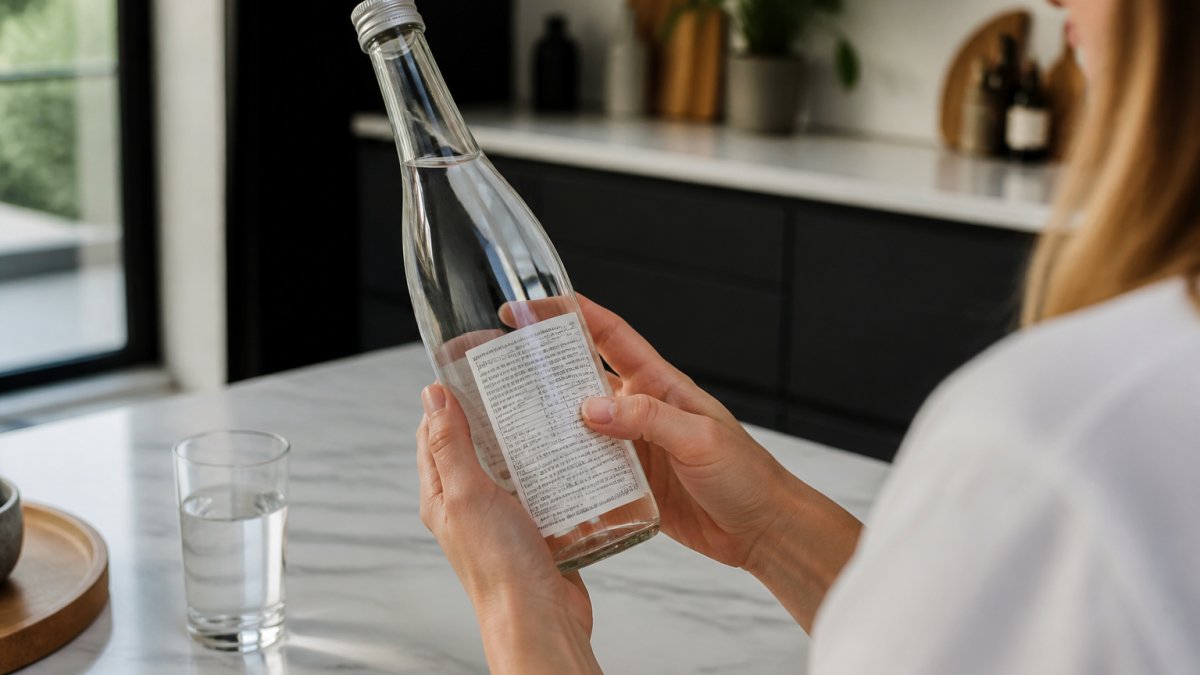
Work through it in this order:
- Source and bottling location. A true natural mineral water names its source and is bottled at it.
- Mineral composition table. Look for calcium, magnesium, sodium, bicarbonate, and total dissolved solids in milligrams per liter.
- Trace elements. Gold, silver, and other metals should appear as trace values, not headline claims.
- Treatment statement. Natural mineral water should not be chemically treated; filtration at the source is standard.
- Electrolytes. Sodium, potassium, magnesium, and calcium are the electrolytes that actually matter for hydration.
A label that leads with "gold" but hides the mineral table is telling you where its priorities are.
Units, detection limits, and what the numbers actually mean
Most labels report minerals in milligrams per liter (mg/L), equivalent to parts per million. Trace metals like gold and silver are usually reported in micrograms per liter (µg/L), or parts per billion, a thousand times smaller.
Chemical form matters too. Dissolved ions behave differently from suspended particles (colloidal gold or silver). A table reporting only total metal content does not tell you which form is present, and form determines absorption, safety, and whether the product is a mineral water or a supplement.
How to verify a concentration claim
Labels are marketing documents; test reports are evidence. If a brand claims a specific gold or silver concentration, ask for:
- The analytical method. Inductively coupled plasma mass spectrometry (ICP-MS) is the standard laboratory technique for detecting trace metals at microgram and sub-microgram levels. A report that names the method and the detection limit is far more credible than a number with no method attached.
- The testing laboratory. Independent, accredited labs (look for ISO/IEC 17025 accreditation) are the norm for credible mineral analyses. In-house results without third-party confirmation are weaker evidence.
- The sampling date and batch. Mineral content can vary by source and season; a report should identify when and from which batch the sample was drawn.
Contaminants and purity statements
Mineral composition is only half the label. The other half is what should not be there. For a plain-language reference on what those standards cover, see the FDA's bottled water guidance.
A label that emphasizes gold or silver while saying nothing about contaminants has answered the wrong question. Judge the water on its full profile, source, mineral table, treatment, and purity testing, and treat the trace-metal story as a footnote.
Natural Mineral Water vs. Colloidal or Infused Water: A Practical Comparison
Natural mineral water and colloidal or infused water differ in origin, concentration, regulation, and purpose. Natural mineral water is groundwater with a stable mineral composition, protected at source and regulated as a food.
| Feature | Natural Mineral Water | Colloidal or Infused Water |
|---|---|---|
| Source | Protected underground source, bottled at origin | Manufactured base water with added ingredients |
| Gold and silver level | Trace, geochemical, micrograms per liter | Deliberately concentrated or suspended |
| Regulation | Regulated as food; composition must be stable | Often sold as a supplement; limited oversight |
| Mineral balance | Naturally occurring electrolytes | Formulated, variable batch to batch |
| Best for | Daily hydration, dining, hospitality | Not a substitute for drinking water |
For a naturally occurring example, AUR'A Gold Water is bottled at its source in the Banat Mountains, with a naturally alkaline pH of approximately 8.25 and trace gold and silver occurring as part of its mineral signature rather than as an additive.
Health Claims and Scientific Evidence: What Holds Up
Health claims about gold and silver in mineral water do not hold up as medical claims. There is no established dietary requirement for either metal, and no credible evidence that trace amounts in drinking water produce therapeutic effects. The science supports hydration and mineral intake, not metal-based wellness.
What is established, what is plausible, and what is marketing
Sort claims into three buckets rather than treating them all as equally credible.
Established. Water is necessary for hydration, and dissolved minerals such as calcium, magnesium, sodium, and potassium contribute to electrolyte content.
Plausible but unproven in drinking water. Silver has well-documented antimicrobial properties in laboratory and industrial settings, which is why silver compounds are used in water purification and some medical devices.
Marketing. Claims that gold or silver in water "energizes," "detoxifies," "boosts immunity," or treats a disease are not supported by established evidence. For the official position, see the FDA's consumer warning on colloidal silver products.
The dose and form problem
Most wellness claims about gold and silver in water collapse on the dose question. A trace concentration in micrograms per liter is orders of magnitude below any level at which a pharmacological effect has been demonstrated, and for gold, no such effect in humans has been established at any dose.
The honest framing is provenance, not therapy. Trace gold and silver in a natural mineral water are a geochemical signature of the source, not a supplement, and they should not be priced or marketed as one.
How to assess a claim yourself
When you encounter a health claim about gold or silver in water, ask four questions:
- What is the dose? If the product does not state a concentration in a defined unit, the claim cannot be evaluated.
- What is the form? Dissolved, suspended, or compound, the form determines how the metal behaves in the body.
- What is the evidence? Look for independent, peer-reviewed research on the specific form and dose, not testimonials or brand-authored summaries.
- What does the regulator say? Check the FDA and CDC positions on colloidal silver and on drinking-water contaminants before trusting a wellness claim.
A common mistake is conflating "contains a trace element" with "delivers a benefit." The two are not the same, and reputable brands should say so plainly. If you want to verify a product's provenance claims, ask for third-party testing and the source certification, and cross-check against the National Sanitation Foundation's bottled water standards.
At AUR'A Gold Water, we treat gold and silver as part of the water's natural character, not as a health promise. The Diamond Taste Award from the International Taste Institute reflects taste and quality, which is the standard we would want you to judge us by.
Conclusion
Choosing a premium water means deciding what you are actually paying for: source, purity, taste, and presentation, or a story about metals that cannot do what the label implies. Get the first four right and the bottle earns its place at the table.
AUR'A Gold Water offers naturally occurring trace gold and silver, bottling at the source in the Banat Mountains, still and sparkling varieties in glass, and complimentary nationwide shipping with flexible subscriptions you can pause, skip, or cancel. Shop AUR'A and taste the difference provenance makes.
Frequently Asked Questions
Is it safe to drink water with silver in it?
Trace silver that occurs naturally in mineral water is not the same as added colloidal silver. Silver in drinking water safety comes down to dose and form: dissolved trace amounts in a natural source are far lower than the silver concentrations people consume in colloidal products. The FDA has not approved colloidal silver for any medical use, and long-term high intake is linked to argyria, a permanent blue-gray skin discoloration. If a label lists silver, check the concentration in milligrams per liter and whether it is naturally occurring or added.
Can gold and silver occur naturally in mineral water?
Yes. Water traveling through mineral-rich rock can pick up trace elements, including minute amounts of gold and silver, along with calcium, magnesium, and bicarbonate. These concentrations are typically measured in micrograms or very low milligrams per liter, which is why they appear as trace elements rather than active ingredients. The key distinction is natural occurrence versus fortification: a spring-sourced water carries what the geology gives it, while an infused product has metals added deliberately. Read the composition label to tell which one you are buying.
Are gold and silver in bottled water added or naturally occurring?
It depends on the product. Natural mineral water bottled at the source contains only what the aquifer provides, so any gold or silver is naturally occurring and usually present in trace amounts. Colloidal or infused waters add metallic particles or ions on purpose, often at much higher concentrations. A mineral water composition label will show the analyzed mineral content per liter; if gold or silver is not listed, it is not a meaningful part of the profile. Ask the brand for source testing if the claim matters to you.
Is mineral water with trace elements different from colloidal silver or gold water?
They are different categories. Natural mineral water with trace elements is drinking water defined by its source and mineral profile, regulated as a beverage. Colloidal silver or gold water is a suspension of metal particles, often sold as a supplement, and carries very different safety considerations, including colloidal silver water risks such as argyria with prolonged high intake. For everyday hydration, a naturally sourced mineral water with a documented composition is the simpler and better-understood choice.