Best Exclusive Mineral Signature for Authentic Origin Water
Table of Contents
- What Makes a Mineral Signature Exclusive
- How to Read a Bottled Water Label Without Guessing
- What a Mineral Water Analysis Report Actually Tells You
- How to Verify Bottled Water Source Before You Buy
- Natural Spring Water Authenticity: What Separates Proof From Story
- Still Versus Sparkling: Choosing the Right Expression of a Mineral Signature
- Regulatory and Labeling Requirements for Origin Water
- A Repeatable Workflow for Selecting Authentic Origin Water
- Frequently Asked Questions
Last Updated: October 21, 2026
What Makes a Mineral Signature Exclusive
Most buyers chase the best exclusive mineral signature for authentic origin water by trusting the label. That is the wrong starting point. A label is marketing.
Water travels through stone for years, collecting calcium, magnesium, sodium, bicarbonate, sulfate, and chloride.
That is why origin matters more than packaging. A bottle can look premium and still hold ordinary water.
Reading the Numbers Behind the Taste
Taste follows chemistry, not branding. High calcium reads chalky and soft. High bicarbonate feels round on the tongue. Magnesium adds a faint bitterness.
The number that ties it together is total dissolved solids, or TDS, which measures everything dissolved in the water in milligrams per liter.
AUR'A sits at roughly 430 mg/L TDS with a pH of about 8.25.
How to Read a Bottled Water Label Without Guessing
Learning how to read a bottled water label comes down to four fields. Find them and you can judge most bottles in under a minute.
- Source location: the actual spring or well, not just a country
- Treatment: "bottled at the source" versus treated municipal supply
- Mineral panel: calcium, magnesium, sodium, bicarbonate, sulfate, chloride
If a label hides the mineral panel, that is a signal. Premium water usually prints it with pride.
Watch the word "natural." Under FDA labeling rules for bottled water, "natural" carries specific meaning, but it does not prove the water came from a protected spring.
Also check the treatment line. "Bottled at the source" means the water never leaves the site before bottling.
What a Mineral Water Analysis Report Actually Tells You
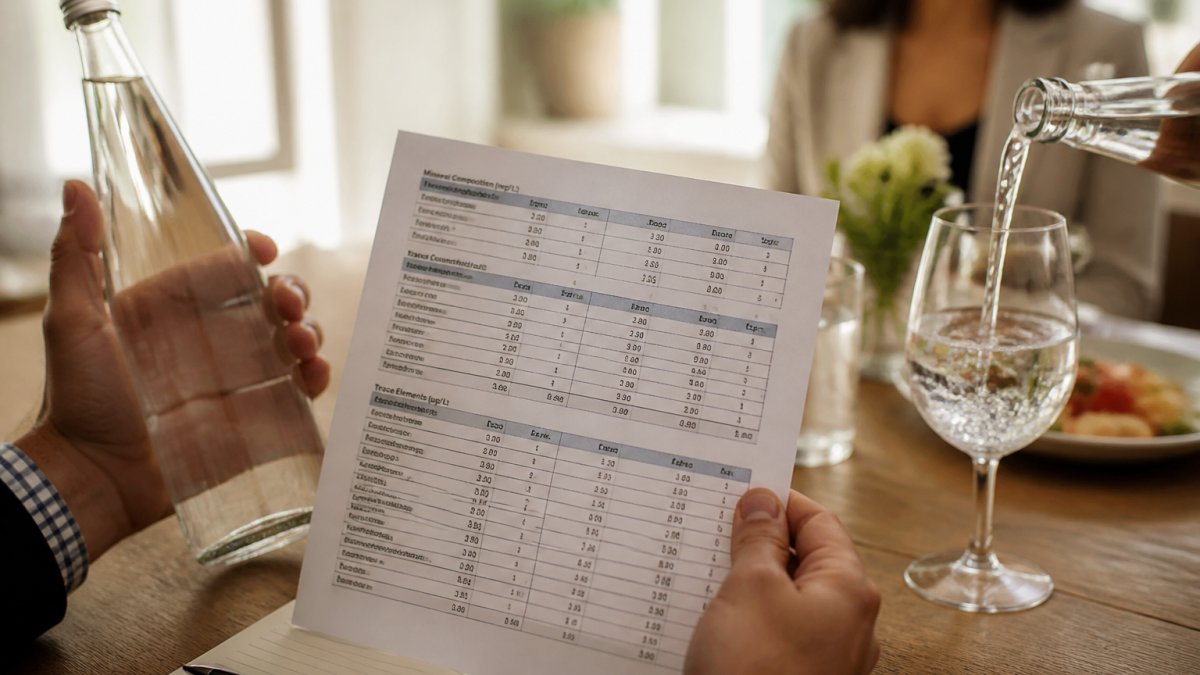
A mineral water analysis report is a lab document listing each dissolved mineral by concentration. It turns a vague origin story into numbers you can compare across brands, but only if you know how to read it. Stopping at TDS and pH is like judging a wine by its alcohol percentage.
Here is the framework to use.
Start With Units and Detection Limits
Most U.S. reports express major ions in milligrams per liter (mg/L), equivalent to parts per million (ppm), and trace elements in micrograms per liter (µg/L), or parts per billion (ppb).
Check the method detection limit (MDL) for each element. If a lab reports "gold: not detected" but the detection limit is 5 µg/L, the water could contain 4 µg/L and still read as zero.
Read the Major Ions as a Group
The six numbers that define most mineral signatures are calcium, magnesium, sodium, potassium, bicarbonate, and sulfate, with chloride and silica rounding out the picture. Read them as ratios, not one at a time:
- Calcium-to-magnesium ratio. High calcium with low magnesium reads chalky and soft; the reverse reads faintly bitter and sharper. A 3:1 calcium-to-magnesium ratio tastes very different from 1:1 at the same TDS.
- Bicarbonate-to-calcium ratio. Bicarbonate buffers acidity and gives water a round, soft mouthfeel. Water high in both calcium and bicarbonate often tastes "creamy" compared with water high in sulfate.
- Sodium and chloride. Even modest sodium (above roughly 20 mg/L) starts to push toward a salty edge; chloride sharpens it.
Place TDS in Context
TDS is the sum of everything dissolved, useful as a band, not a precise number:
- Under 50 mg/L: very low mineral, soft and light; the signature is hard to taste.
- 50-250 mg/L: low to moderate; clean and easy-drinking, common in premium still waters.
- 250-500 mg/L: moderate; minerals become perceptible and the signature is readable in a glass.
Two waters at 430 mg/L can taste completely different if one is calcium-bicarbonate dominant and the other sodium-chloride dominant. TDS tells you how much; the ion panel tells you what.
Check the Charge Balance
A credible lab report will balance: positive charges from cations (calcium, magnesium, sodium, potassium) should roughly equal negative charges from anions (bicarbonate, sulfate, chloride, nitrate). Most practitioners accept a charge-balance error under about 5% as internally consistent; a report off by 20% suggests a missing ion, transcription error, or lab problem. Many labs print the balance, ask for it.
Look at the Date, Lab, and Chain of Custody
Water chemistry is stable, but a report should be recent enough to reflect current bottling. Check three things:
- Named laboratory. A real report identifies the lab and its accreditation.
- Sample date and bottling date. They should be close.
- Chain of custody. For authenticity claims, the report should show the sample was drawn at the source, not from a retail bottle.
A Quick Comparison Worksheet
When you compare two reports side by side, tabulate TDS (mg/L), pH, calcium, magnesium, sodium, bicarbonate, sulfate, chloride, silica, and any trace elements with their detection limits. Then compute two ratios, calcium:magnesium and bicarbonate:sulfate. Those ratios, more than any single number, tell you whether two waters with the same TDS will taste alike. They usually will not.
How to Verify Bottled Water Source Before You Buy
To verify bottled water source, match four things: the label claim, the regulatory record, the lab report, and an independent audit trail. When all four agree, the origin story holds up. When any one is missing, you are relying on marketing.
1. Read the Source Statement Against the Regulation
Under FDA labeling rules for bottled water, a "spring water" label requires water drawn from a named spring, and the label must carry a source statement.
For imported water, the same discipline applies: the source statement should identify the spring, and the importer should be able to produce the foreign bottler's registration and the U.S. importer-of-record documentation.
2. Check the Regulatory Record
Bottled water in the U.S. is regulated as a food by FDA, and the source water itself is protected under EPA's source water protection programs. Two practical checks follow:
- Bottler registration. FDA requires bottled water processors to register and to operate under current good manufacturing practice. A brand should be able to tell you its registration status.
- State source approval. Many states require bottled water sources to be approved and inspected. A brand drawing from a U.S. spring should be able to name the state approval.
These records do not prove exclusivity, but they prove the source is a real, regulated water source rather than a marketing fiction.
3. Match the Lab Report to the Source Geology
The mineral panel should be consistent with the geology the brand claims: limestone country should show calcium and bicarbonate dominance, volcanic rock may show higher silica or sulfate.
Look for the sample date and chain of custody. A report drawn from a retail bottle proves what was in that bottle, not what comes out of the spring.
4. Ask for the Independent Audit Trail
Third-party testing is the strongest single signal, but "third-party tested" is a phrase, not a document. Ask for:
- The name of the laboratory and its accreditation.
- The method used for each element (ICP-MS for trace metals, ion chromatography for anions).
- The detection limits, so you know what "not detected" actually means.
A brand that can produce these on request is telling the truth. A brand that answers with a mood board is telling a story.
5. Use Trace Elements Carefully
Trace elements tied to a single geological formation are hard to replicate and can support an origin claim, but only when the report states the method and detection limit. A trace element reported as "present" without a concentration or detection limit is not evidence. With named methods and limits, origin becomes verifiable rather than assumed.
Authenticity is provable, not poetic. A source statement, a regulatory record, a source-drawn lab report with named methods and detection limits, and an independent audit trail together do more than any origin story on a label. Ask for all four before you buy.
Natural Spring Water Authenticity: What Separates Proof From Story
Natural spring water authenticity rests on documentation, not adjectives. "Spring," "artesian," and "mountain" are descriptive words. Proof lives in records.
Ask these questions:
- Does the brand name the exact spring or well?
- Is there a current lab report from a named lab?
- Is the water bottled at the source or trucked elsewhere?
A brand that answers all four with documents is telling the truth. A brand that answers with a mood board is telling a story.
Still Versus Sparkling: Choosing the Right Expression of a Mineral Signature
Carbonation changes how a mineral signature reads. The minerals stay the same. The sensation does not.
Still water lets you taste the full profile. The calcium, the bicarbonate, the soft alkaline finish. It is the honest version of the source.
Sparkling water adds carbon dioxide. The bubbles lift aromas and sharpen the finish, making a mineral-forward water taste brighter and more refreshing, though the fine detail gets a little masked.
Choose by moment:
- Still: fine dining, tasting flights, guests who want the pure profile
- Sparkling: toasts, aperitifs, events that need lift and energy
Hosts who want one water to cover a whole evening should serve both. Still for the table, sparkling for the toast.
Regulatory and Labeling Requirements for Origin Water
Origin claims are regulated. In the U.S., bottled water falls under FDA bottled water standards, which set rules for source labeling, quality, and what "spring water" may mean.
Key points buyers should know:
- A "spring water" label requires water drawn from a named spring.
- Source statements must be accurate and specific.
- Mineral claims must match tested values.
The EPA's role in source water protection covers the safety of the water sources themselves.
For imported water, expect the same discipline. A serious European brand will supply lab reports and certification on request.
A Repeatable Workflow for Selecting Authentic Origin Water
Use this five-step workflow every time you evaluate a new water.
| Step | Action | What It Proves |
|---|---|---|
| 1 | Read the source statement | Where the water comes from |
| 2 | Request the full mineral panel | What the signature contains |
| 3 | Confirm bottled-at-source | The profile is protected |
| 4 | Check third-party testing | The claims are verified |
| 5 | Compare across candidates | Which signature is truly exclusive |
Step 2: Request the full mineral panel. Look at ratios, not just TDS.
Step 3: Confirm bottled at the source. This protects the signature from change.
Step 4: Check third-party testing. A named lab and method build trust.
That last step is where AUR'A earns its place.
For a daily pour, the AUR'A 330 ml case of 12 works well. For the table, the AUR'A 750 ml case of 6 is built to be shared. And to try both expressions at once, the AUR'A Gift Box pairs still and sparkling from the same source.


Frequently Asked Questions
What is a mineral signature in natural mineral water?
A mineral signature is the specific combination of dissolved minerals and trace elements, such as calcium, magnesium, sodium, bicarbonate, sulfate, and chloride, that a water picks up as it moves through its source geology. It shapes taste, mouthfeel, and pH. A truly exclusive mineral signature comes from a single protected source and stays consistent from bottle to bottle, which is why a documented mineral profile matters more than a marketing story.
How can you verify where bottled mineral water comes from?
Start with the label: look for a named source, a bottling location, and a mineral analysis report. Then cross-check the source against the producer's published testing data and any third-party laboratory results, such as ICP-MS analysis. A credible brand will confirm the source origin and bottling point without hesitation. If the label is vague about where the water is drawn and bottled, treat the origin claim as unverified.
Does a water's mineral composition prove its source?
No. A mineral profile shows what is dissolved in the water, not where it came from. Two sources can share similar calcium or bicarbonate levels. Provenance needs separate evidence: a named spring or borehole, bottling-at-source documentation, and laboratory reports tied to that location. Use the mineral signature to judge character and consistency, and use source verification to confirm authenticity.
What should you look for in a bottled water mineral analysis?
Look for total dissolved solids, pH, and the main ions: calcium, magnesium, sodium, bicarbonate, sulfate, and chloride. Check whether trace elements are listed and how they were measured, such as ICP-MS. A useful report states the testing laboratory and date. Compare the numbers across still and sparkling versions, since carbonation changes the reading. Consistent figures across batches are a strong sign of a stable, well-documented source.
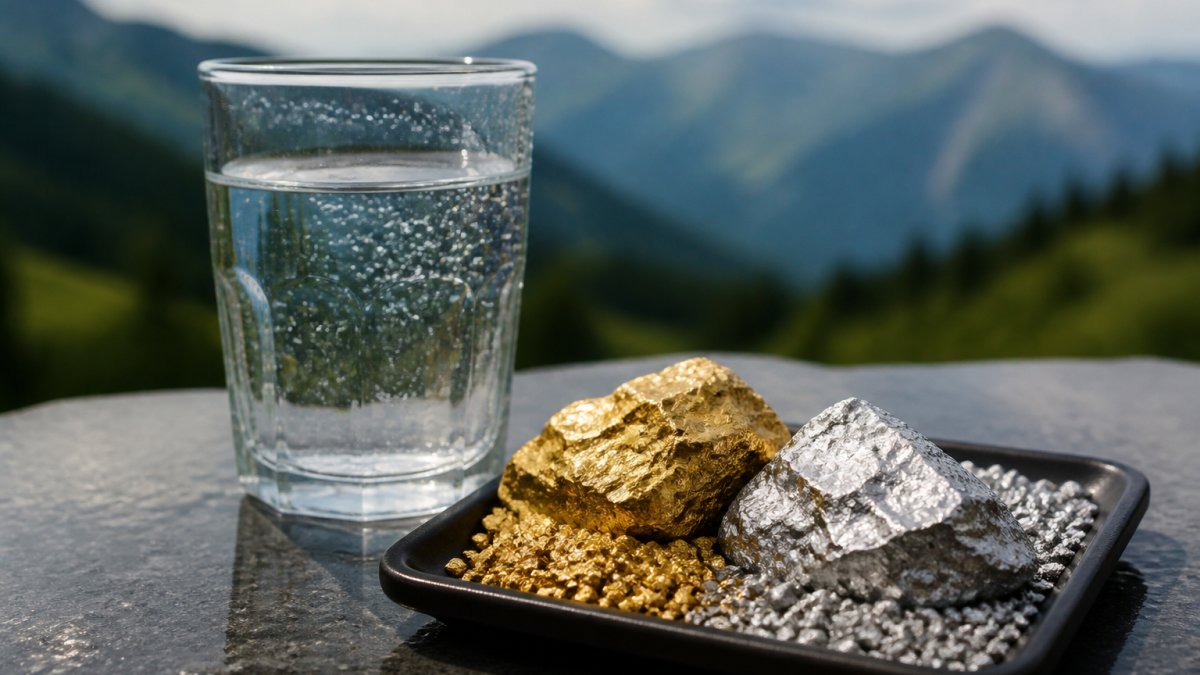
The hardest part of choosing origin water is separating proof from packaging. Most brands ask you to trust the label. We would rather you check the numbers, read the lab report, and taste the result. AUR'A Gold Water is bottled at the source in the Banat Mountains, carries trace gold and silver confirmed by ICP-MS analysis, and ships free nationwide with a subscription you can pause, skip, or cancel anytime. Shop AUR'A and taste a mineral signature you can actually verify.